Latest Updates
Toll free: 1-800-212-3001 Apply online Pay online



Blog
Blog
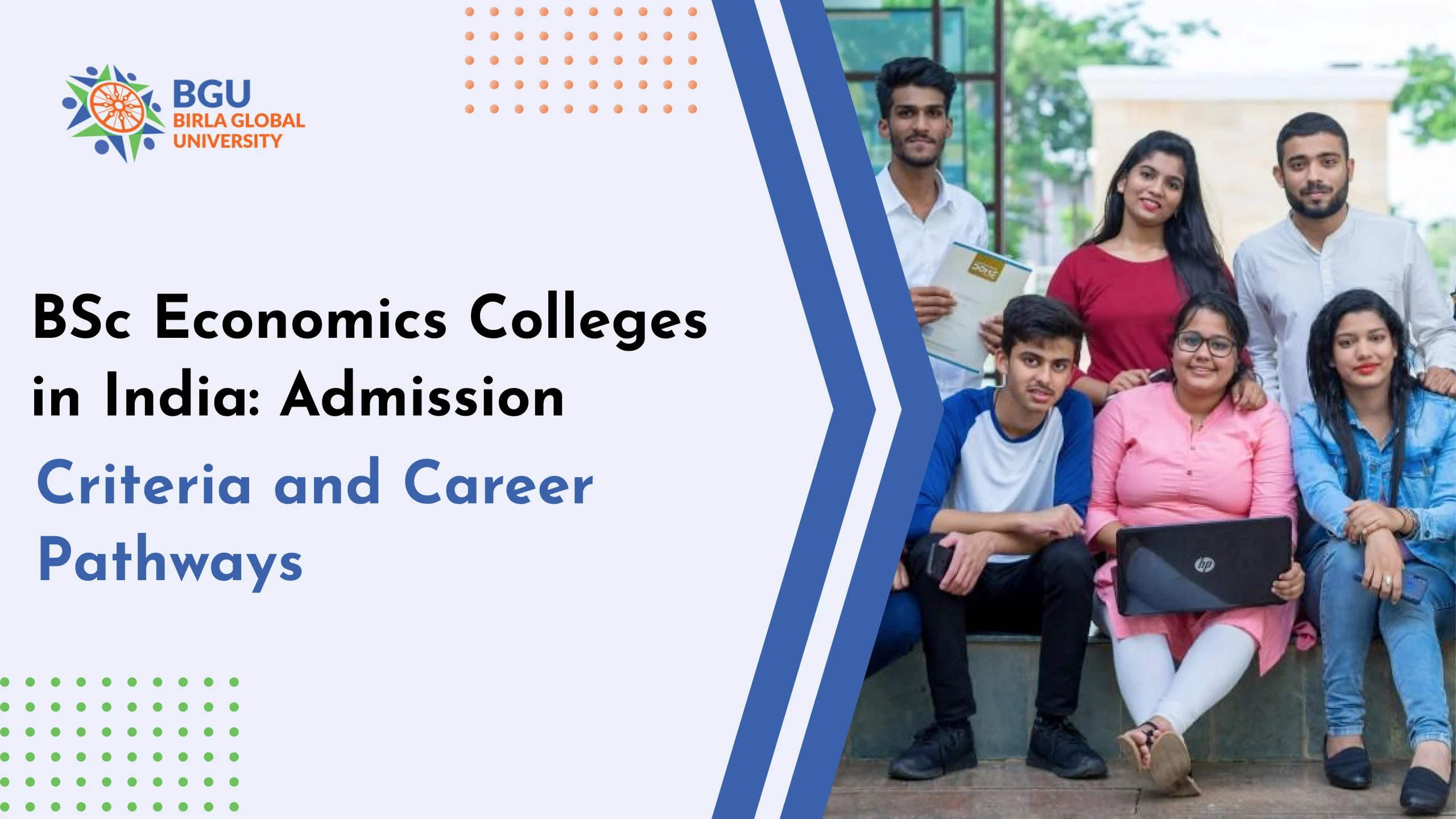
If you enjoy learning about economic market functions, reason for price increases and the way governments determine on large economic spending, finding a suitable BSc in Economics should be the appropriate way to start. Economically India is currently going through a huge transformation, meaning that there has never been more necessity for trained graduates in this field of study. There are so many options available for you regarding BSc Economics colleges in India!
This guide will explain to you everything from topics covered to the types of people who can apply to how many career opportunities will be available to you after graduation. Let's get started.
The BSc Economics is a three-year undergraduate degree that combines economic theory with quantitative tools like statistics, mathematics, and data analysis. It's offered by several universities across India and prepares students for roles in research, analytics, finance, and policy.
Institutions like Birla Global University (BGU), Bhubaneswar, offer a BSc Economics (Hons.) as well as a BSc Economics (Hons. with Research) — a four-year program for those who want to go deeper into academic and applied research.
BSc economics colleges in India typically structure their curriculum around a blend of foundational theory and applied tools. At BGU, the program is designed to give students a firm grounding in economic concepts alongside practical skills used in real-world analysis.
Here are some of the core areas usually covered:
BGU's Birla School of Economics also provides hands-on training through an Econometrics Lab, where students learn to use industry-relevant software for data analysis — a skill that's in high demand across industries today.
This is a question many students ask, and it's a fair one. While both degrees explore economic theory, there are key differences in approach.
| Feature | BSc Economics | BA Economics |
| Primary Focus | Quantitative and analytical methods | Theoretical and social perspectives |
| Mathematics | Heavy emphasis — often compulsory | Limited or moderate use of maths |
| Career Leaning | Analytics, research, finance, data | Policy, journalism, civil services |
| Program Duration | 3 to 4 years | 3 years |
| Ideal For | Students with strong maths background | Students from humanities stream |
In simple terms, BSc Economics is more data-driven and maths-oriented, while BA Economics leans more towards social science reasoning and policy discussions.
Understanding the admission process before you apply saves a lot of confusion later. The good news is that the eligibility requirements are fairly straightforward for most BSc economics colleges in India.
At Birla Global University, the eligibility for the BSc Economics program is clear and accessible:
This means students from both the Science and Commerce streams can apply, as long as they have one of these subjects in their background. Having Mathematics is particularly advantageous because it helps students handle the quantitative aspects of the program more comfortably.
Key things to keep in mind before applying:
Different BSc economics colleges in India follow different selection processes. Some rely purely on Class 12 marks, while others conduct their own entrance tests.
At BGU, the university conducts the BGU Entrance Test (BET) as part of its admission process. This test helps the institution assess candidates' academic readiness beyond just board exam scores.
| Selection Mode | Description |
| Merit-Based | Admission based on Class 12 percentage |
| Entrance Test (BET) | BGU's own entrance test for UG programs |
| State Counselling | Some colleges follow centralised state counselling |
| Personal Interview | Some institutions add an interaction round |
It's always a good idea to keep an eye on the official university website for the latest admission schedules and test dates.
What Top BSc Economics Colleges in India Emphasize
Not all economics programs are created equal. The best BSc economics colleges in India go beyond textbook teaching and focus on preparing students for the real world.
Quantitative Skills, Data Analysis, and Economic Modeling
One of the biggest advantages of a well-structured BSc Economics program is its emphasis on quantitative economics. At Birla Global University (BGU), the Birla School of Economics integrates practical lab work with theoretical learning. Students are trained to use industry-relevant software for econometric analysis, economic modelling, and data interpretation.
Key quantitative skills students typically develop include:
These skills make BSc Economics graduates highly attractive to employers in banking, consulting, fintech, and public policy.
Practical Exposure Through Projects and Research
BGU's BSc Economics (Hons. with Research) goes a step further by offering students a structured research pathway across four years. The program is also aligned with the NEP 2020 framework, which encourages multidisciplinary learning and flexibility.
Practical elements that top colleges typically offer include:
BGU also offers an exclusive international pathway — BSc Economics (Hons.) students can pursue a Master of Science in Marketing (STEM) at the Martin J. Whitman School of Management, Syracuse University, New York. This kind of global opportunity is rare among Indian undergraduate economics programs and reflects the forward-thinking approach of leading institutions.
Career Pathways After Completing BSc Economics
One of the most common questions students ask is — "What can I actually do after a BSc Economics degree?" The answer: quite a lot.
Roles in Analytics, Finance, and Economic Research
BSc Economics graduates are well-suited for a range of roles across private and public sectors. The combination of analytical thinking, data skills, and economic understanding makes them versatile professionals.
Popular career roles include:
Companies like KPMG, PwC, SBI, HDFC, Axis Bank, and many others actively recruit economics graduates — and these are exactly the kinds of recruiters that visit BGU's campus.
Higher Education Options in Economics and Related Fields
Many BSc Economics graduates choose to continue studying after their undergraduate degree. This is also a great path if you want to specialise further or move into academia.
| Postgraduate Option | What It Leads To |
| MSc Economics | Advanced research and teaching roles |
| MBA | Management, finance, and leadership roles |
| MA Economics | Civil services, policy, and social research |
| MSc in Data Science | Tech companies, analytics firms |
| PhD in Economics | Academic and think tank careers |
| CFA / CA | Finance and investment sectors |
At BGU, students can progress directly to the MSc Economics program offered by the Birla School of Economics, making it easy to continue within a familiar and supportive academic environment.
How to Choose the Right BSc Economics College
With so many options across India, choosing the right college can feel overwhelming. Here are some practical factors to evaluate:
BGU checks many of these boxes — it is NAAC accredited, NEP 2020 compliant, has globally experienced faculty, strong industry recruiter relationships, and an international university partnership that gives BSc Economics students a pathway to study abroad.
Conclusion
A BSc Economics degree is a brilliant decision in today's data-friendly and policy-oriented world. It doesn't matter if you want to be a financial analyst, a research economist, or go abroad to study further; building a proper undergraduate foundation is essential. The best BSc economics colleges in India are those that provide high academic quality and opportunities to apply what you've learned in the real world. Institutions like Birla Global University want to do this with the Birla School of Economics.
If you're looking for a program that focuses on preparing you for modern-day careers in analytics, economics and policy research, then consider BGU’s BSc Economics (Hons.). Be patient and take your time; gap your alternatives and make an appropriately-informed decision. Ultimately, your career in economics will begin with your choice of degree.
Frequently Asked Questions (FAQs)
What is the eligibility criteria for BSc Economics colleges in India? Most programs require candidates to have passed Class 10+2 from a recognised board with a minimum of 50% marks. Candidates should have studied either Mathematics or Economics at the senior secondary level. Requirements may vary slightly by institution, so always check the specific college's admission guidelines.
Is mathematics compulsory for admission to BSc Economics programs? At many BSc economics colleges in India, including BGU, Mathematics is not strictly compulsory — Economics as a 10+2 subject is also accepted. However, a background in Mathematics is highly beneficial since the program involves quantitative methods, econometrics, and statistical analysis.
How is BSc Economics different from BA Economics? BSc Economics focuses heavily on quantitative methods, data analysis, and mathematical economics. BA Economics takes a more social science approach, focusing on theory, history of economic thought, and policy. Career paths differ too — BSc graduates often move into analytics and finance, while BA graduates lean towards civil services, journalism, or humanities-based research.
Do BSc Economics colleges in India conduct entrance exams? Yes, some colleges conduct their own entrance exams. BGU, for example, conducts the BGU Entrance Test (BET) as part of its selection process. Other colleges may rely on Class 12 merit. It's advisable to check the specific admission process for each college you're considering.
What skills do students develop during a BSc Economics program? Students develop a strong mix of analytical, technical, and communication skills — including economic analysis, data interpretation, statistical modelling, econometric tools, critical thinking, research writing, and the ability to apply economic concepts to real-world problems.
What career options are available after completing BSc Economics? Graduates can pursue roles such as Economic Analyst, Data Analyst, Financial Analyst, Research Associate, Policy Analyst, Business Analyst, and Credit Analyst across banking, finance, consulting, government, NGOs, and technology sectors.
Can students pursue higher studies after BSc Economics in India? Absolutely. Graduates can pursue MSc Economics, MBA, MA Economics, MSc Data Science, or a PhD in Economics. Professional certifications like CFA or CA are also popular choices. BGU even offers its BSc Economics students a pathway to an international master's program at Syracuse University, USA.
