Latest Updates
Toll free: 1-800-212-3001 Apply online Pay online



Blog
Blog
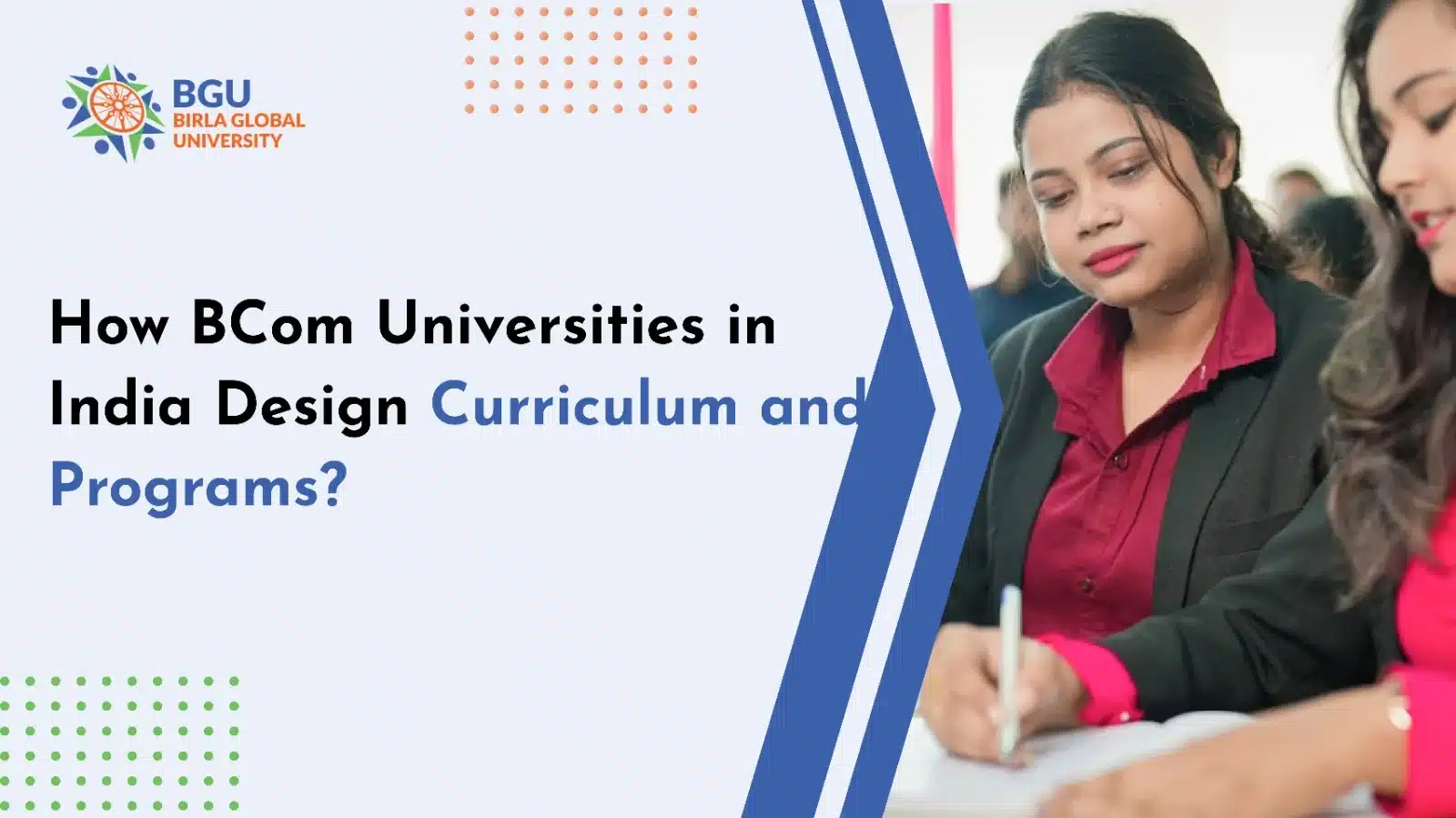
B.Com university in India design their programs and curriculum by making sure that the goals and objectives of the program are aligned with the current trends and standards of the industry. The leading universities offering the Bachelor of Commerce degree create an environment where students are provided with an education that readies them for the challenges they might face after completing their degree.
Universities like Birla Global University (BGU) offer students a full-time BCom with an option to extend the program by another year and convert the degree into BCom (Hons.). BGU, being one of the leading universities in India have set an example by designing its program based on the latest NEP 2020 guidelines.
Curriculum plays an important role when it comes to choosing a BCom university. The entire curriculum needs to be designed in such a way that a combination of domain knowledge, knowledge of information technology, and industry interface is maintained. BCom university in India, like BGU, has an educational model that is pretty flexible and designed to be student-centric. BGU follows Choice Based Credit System (CBCS), a model devised by the UGC to allow students to choose their courses and subjects at their own speed.
For students, they must choose a BCom university where the curriculum is up to date and has relevance to the needs of the industry. A curriculum that is designed to meet the needs of the industry helps the students to get ready to face different challenges.
The following are the core subjects covered in the BCom university in India:
A commerce education is highly affected by exposure to the industry. Unlike technical programs like B.Tech, where a heavy emphasis is placed on theoretical knowledge and its practical application, a BCom degree requires students to be exposed to the industry. This helps bridge the gap between classroom knowledge and the challenges faced in the real world.
A BCom university in India, like BGU, provides its students with opportunities to interact with the leaders of the industry. This helps the students to learn from the first-hand experience of the companies and their major stakeholders.
The current placement trends in the BCom university in India show that there is an increasing demand for professionals with a higher skillset in finance, analytics, and the usage of digital tools. These skills can be attained through a BCom degree; however, students with an interest in these areas usually have a higher ceiling of learning.
Top BCom universities in India, like BGU, are seeing a massive increase in student placements. Students who receive top-grade education are capable of landing jobs in specialised roles and receiving packages that exceed industry standards. Top sectors where students are being placed are Banking, Financial Services, and Insurance. Some of the top companies like ITC Limited, HDFC Mutual Fund, Deloitte, Airtel, and PWC employ BCom graduates from the best universities.
Universities like BGU provide their students with an in-depth knowledge in areas like Business and Commerce. This helps them in solving real-world business problems using their analytical skills. The graduates from their universities are able to apply teamwork and management skills that help them edge past graduates from other universities and colleges.
Finding the best BCom Universities in India can be a tricky affair. However, it is crucial to understand that getting a BCom program in India in top universities can help in achieving different career-related goals for the students. Top universities like BGU help interested student to not only complete their BCom education but also extend it by a year and get Hons. degree. BCom Hons degree holders are expected to have an in-depth knowledge of core subjects like Accounting and Finance. The specialisation provided in specific subjects allows students to find better jobs and higher salaries.
To find the best BCom University in India, a candidate needs to follow the steps mentioned below:
The scope of a BCom degree in India is highly diverse as it offers multiple opportunities in fields such as accounting, taxation, finance, banking, and management.
Neither BCom nor BBA is better than the other course. However, both degree have their own features and can attract people with different career goals.
Specialisations available in BCom are Accounting and Finance, Taxation, Banking and Insurance, Marketing, and Computer Applications.
Yes, you can do an MBA after BCom. In BCom, students are prepared for business analytics, which is one of the most popular specialisations in MBA programs.
No, maths is not compulsory for pursuing BCom.
The average salary after completion of the BCom degree ranges between 2.5 and 5 LPA.
Yes, internships are included in BCom programs in the form of summer internships between the second and third year.
Yes, university rankings matter a lot when it comes to finding the best BCom universities.
Yes, BCom is suitable for CA preparation as the core subjects among the two remain quite similar.
The most common entrance exam required for admission in the BCom program is the Common University Entrance Test (CUET) UG.
No, placements are not guaranteed for BCom graduates; however, top-performing students often find placements during the on-campus placement season.
Yes, science students can apply for the BCom program as universities accept students from all streams.
Skills like critical thinking, problem solving, accounting, finance, and business are developed through BCom.
To choose the right BCom University, students must judge on the following criteria
