Latest Updates
Toll free: 1-800-212-3001 Apply online Pay online



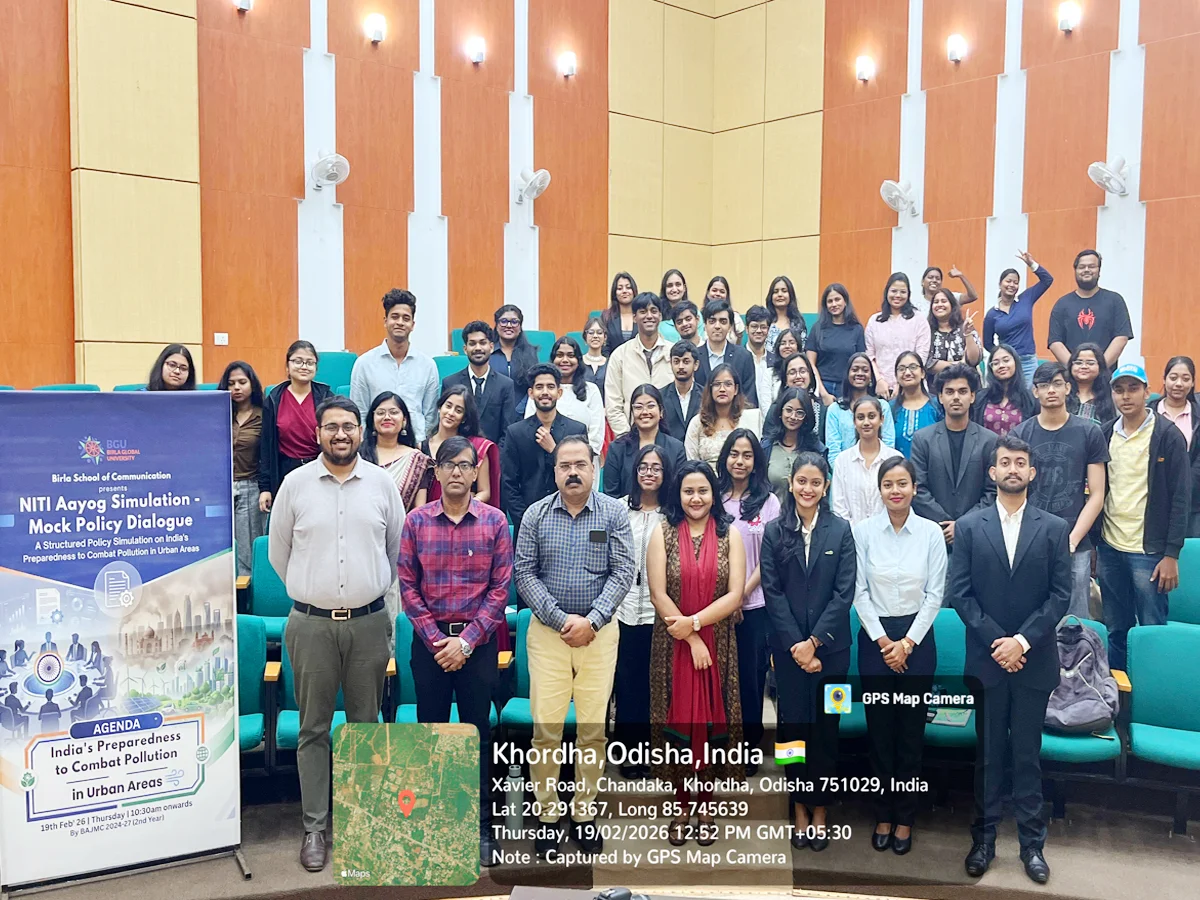
Students of the Birla School of Communication hosted a Mock NITI Aayog Simulation on 19 February in the Seminar Hall, bringing together student delegates to deliberate on the agenda, “India’s Preparedness to Combat Pollution in Urban Areas.” Organised by the BAJMC 2024–2028 batch, the exercise was designed as a structured policy dialogue modelled on an official NITI Aayog meeting, replicating procedural rigour, stakeholder diversity, and consensus-building mechanisms.
The session commenced with a welcome by the student Master of Ceremonies, followed by opening remarks from the Chairperson (Aayesha Puhan), who underscored the importance of cooperative federalism and evidence-based policymaking in addressing complex environmental challenges. The Convenor (Ankit Dash) then outlined the rules of procedure and the flow of deliberations, ensuring clarity and discipline throughout the simulation.
The General Speakers’ segment introduced delegates representing key Union Ministries—Environment, Forest and Climate Change (Sangama Sethi); Housing and Urban Affairs (Shreyansh Padhi); and Power and Renewable Energy (Asutosh Mishra)—alongside State representatives from Delhi (Edha Bhogal), Karnataka (Jhanvi Jena), Maharashtra (Divyansh Bhat), Odisha (Ankita Guru), and Mizoram (Kamalini Deep). Institutional bodies such as the National Green Tribunal (Anuska Patnaik) and the Central Pollution Control Board (Roshan Savana) were also represented, as were international organisations including UNEP (Hridhul Raneesh) and the World Bank (Pratyush Patnaik). Each delegate articulated their mandate, policy priorities, and intended contributions to the discussion.
The deliberations focused on multiple dimensions of urban pollution, including air, water, soil, and noise contamination. Delegates debated the relative significance of vehicular emissions, industrial discharge, construction dust, waste mismanagement, and seasonal factors such as stubble burning. Discussions examined whether stricter enforcement mechanisms, technological monitoring systems, renewable energy transitions, or long-term urban planning reforms offered the most viable solutions.
Moderated caucuses enabled focused exchanges on enforcement challenges, inter-state coordination, and the balance between development and environmental sustainability. The unmoderated caucus fostered informal negotiations and alliance-building, reflecting the collaborative processes characteristic of high-level policy forums. Participants actively questioned one another’s proposals, defended their administrative approaches, and negotiated areas of consensus.
A highlight of the event was the press interaction session, where student journalists representing major media houses (Reuters – Srisa Behera; CNN – Shreya Patnaik; India Today – Priyanka Swain; WION – Pushkal Chatterjee) raised critical questions on accountability, feasibility, and policy continuity. This segment added a realistic dimension to the proceedings, compelling delegates to substantiate their claims with clarity and coherence.
The simulation concluded with a summary of deliberations presented by the Convenor in consultation with the Chairperson, followed by a vote on a proposed resolution outlining recommended policy measures. The collective recommendations emphasised stronger centre–state coordination, consistent implementation of environmental laws, improved urban infrastructure planning, enhanced renewable energy adoption, and greater public awareness initiatives.
Overall, the Mock NITI Aayog Simulation offered participants hands-on exposure to policymaking, negotiation, and governance dynamics. By engaging students in structured debate and collaborative problem-solving, the exercise demonstrated how experiential learning can meaningfully bridge classroom knowledge with contemporary public policy challenges.
